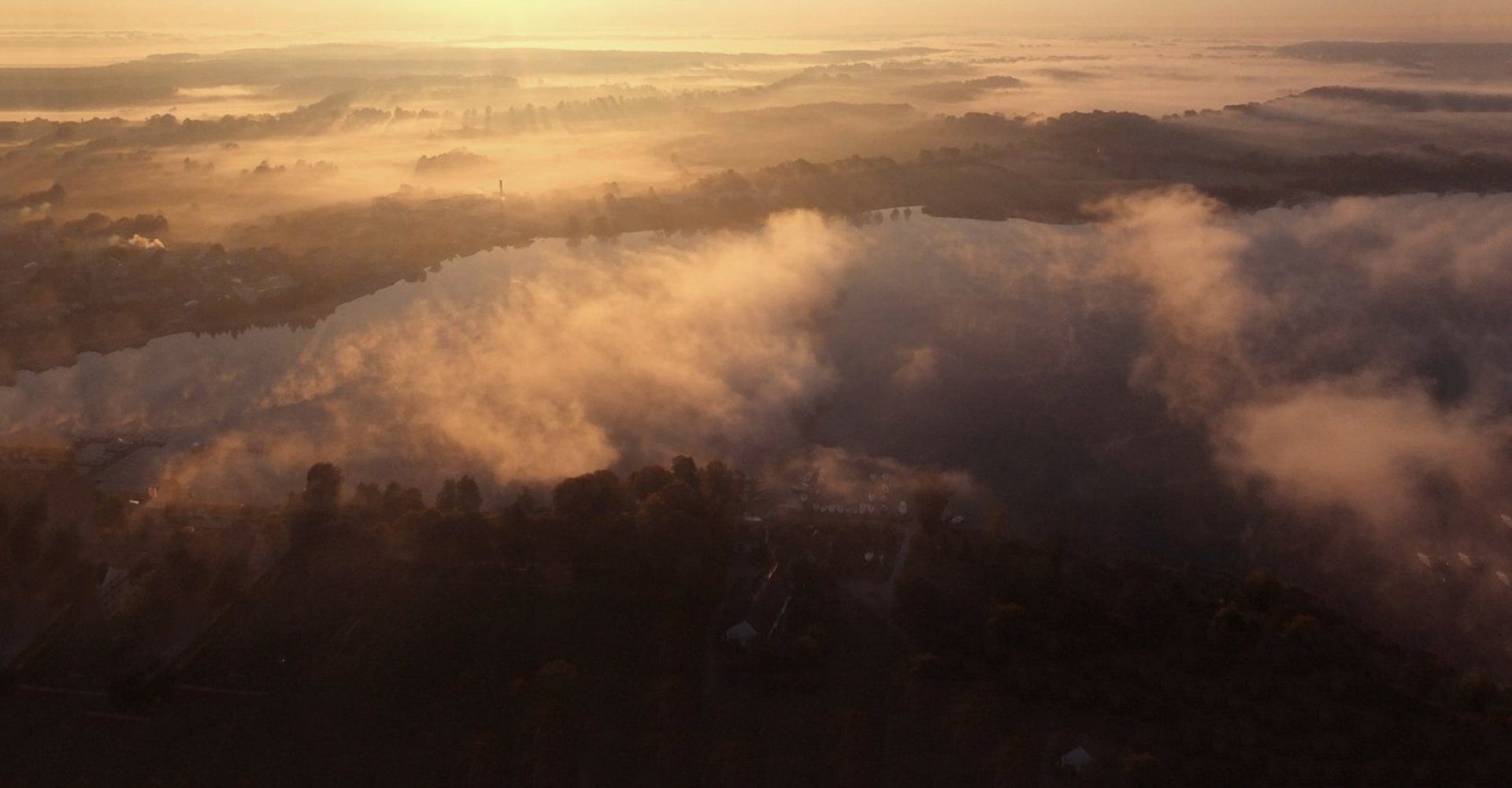
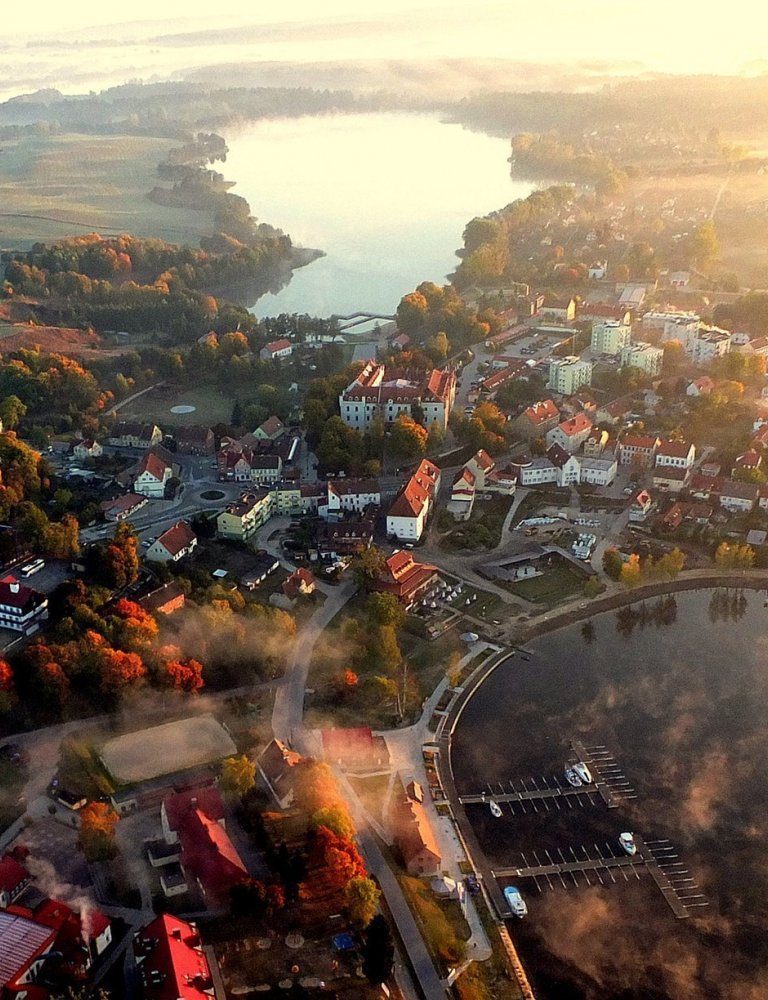
On a beautiful hill between the lakes Ryńskie and Ołów a castle was built. This medieval stronghold was built in stages and those days it looked entirely differently.
The oldest information about the Teutonic Knights castle, which gave a beginning to a settlement and the later town comes from the Wigand’s of Marburg Chronicle dating back the year 1377.
The first phase of the construction works is defined for the second decade of the 14th century, up to the year 1376. The second phase of the works begins in 1377 with the construction of the castle walls, on the 44 x 52 metre rectangle, with a huge pre-castle area. At that time it was planned that two wings were built: the southern-eastern and the northern-eastern (the southern and the northern wing was 56,5 m, and the eastern and western wing was 44,8 m. Their inner width was 17 m). The walls were 4,5 m thick, narrowing down to 2,5 m, and they made the basis for the whole colossus. From the other sides, the square was closed with curtian walls and an untypical square tower in the western corner. It is assumed that those days the encircling walls weren’t higher than the second storey, but the southern-eastern wing was lifted from the ground. Additionally, the encircling walls were reinforced with corner risalit to set the small towers on their crown. Rooms on the ground floor were planned to be covered with wooden ceiling, in others there were cross vaults designed.
After the creation of the Commandry in Ryn, there appeared a necessity for alteration. Then, the cellars and the southern-eastern wing received a new division and cross vaults. In the ground area three rooms were built, for example a spacious hall roofed with a cross vault and leaning against huge pillars. On the first storey there was a chapel, with distinctive windows. Next to it, there was a chapterhouse and the Commander’s apartments. Above it, over the chapel, there was an armoury. The last and the highest storey was surrounded by a gallery. The first storey was connected with higher storeys with wall-thick inner stairs, and the communication in the wing was provided withe a one-storey gallery.
From the southern-eastern side of the castle there was a pre-castle area with a manor. That was assumed to be a farming base. The whole castle area was surrounded by a moat with water from the lake Ołów.
From the 15th century inventory we can learn that the castle consisted of a kitchen, a bakery or even a brewery. In 1507 it is mentioned an attic, a chapel, a powder magazine and an armoury. In 1515-1524 there is the first mention an existence of a chapterhouse, a refectory, a dormitory, writer’s and cook’s rooms, a bath and a guest room. From other inventories it is possible to learn about the existence of a malt house, a cellar, a honey storehouse, a mill, a powder mill, a granary and a textile machine used for making cloth called ‘Walke’. The 18th century four-wing and irregular block with a lenghtened courtyard – was a result of numerous alterations in the 16th century and the later times. First changes were introduced in 1525, and the successive ones in the 17th century, when there was a plan to arrange a comfortable hunter’s residence for the Duke. Then, the southern-western wing with a gate passage and the northern - western one. Every time when the owners of the castle changed, its appearance and its purpose changed as well.